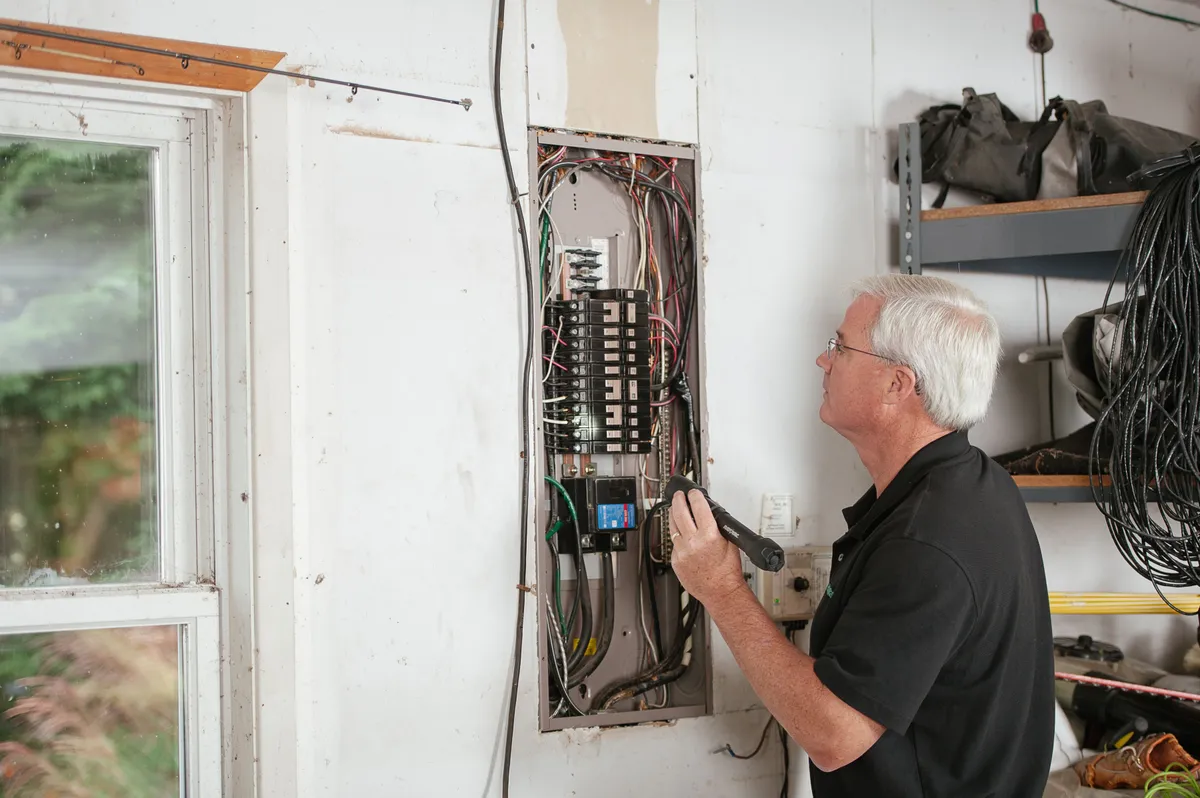
Most electrical calls in Pahrump don’t start with a project. They start with a symptom: a breaker that won’t stay on, lights that dim when the AC kicks in, an outlet that died overnight, a switch plate that feels warm. This page is about that stage — how professional troubleshooting works, what it costs in 2026, which checks are free before you pay anyone, and how to tell a methodical diagnostician from a parts-swapper.
We’re a referral service, not an electrician — we connect Pahrump homeowners with independent licensed contractors. That means our interest is in you getting a correct diagnosis at a fair rate, whoever does the work.
First: the free checks before you pay for a visit
If the problem is “no power” or “partial power,” a few minutes of triage can save a service call:
- Check the VEA outage map. Pahrump’s utility is Valley Electric Association, the member-owned co-op — and their outage map at outages.vea.coop shows active outages in real time. If your area is on it, no electrician can fix that; report it to VEA at (775) 727-5312 (or (800) 742-3330) and wait it out.
- Look at the neighbors. Whole street dark? Utility problem. Just your house? Now it’s worth investigating your own equipment.
- Scan your panel for tripped breakers. A tripped breaker handle sits between ON and OFF; reset it by pushing fully to OFF, then back to ON. If it trips again immediately, stop resetting — repeated forcing of a tripping breaker defeats the one device protecting that circuit.
- Test GFCI buttons. A tripped GFCI in a garage or bathroom can kill outlets in several rooms, because downstream outlets ride on it. Press RESET on every GFCI you can find before concluding the outlets are dead.
If those checks come up empty — or the breaker won’t hold, the GFCI won’t reset, or something is warm or smells hot — it’s time for a professional.
What diagnosis costs in 2026
Electrical troubleshooting in 2026 is generally billed as a service call of $100–$200, which covers the first hour of labor. That first hour is often the whole job: a competent electrician with a meter can run down a dead outlet or a nuisance-tripping GFCI and fix it inside the window. Beyond the first hour, expect $50–$100/hr for journeyman-level work and $90–$130+/hr for a master electrician on more complex diagnosis. Some shops also charge a trip fee of $40–$100, sometimes waived if you approve the repair — ask when you book.
| Billing item | 2026 typical range |
|---|---|
| Service call (first hour included) | $100–$200 |
| Journeyman hourly, after first hour | $50–$100/hr |
| Master electrician hourly | $90–$130+/hr |
| Trip fee (when charged separately) | $40–$100 |
| Emergency / after-hours rate | $150–$200/hr |
Two ways to get more value from the visit: batch your small jobs — the dead outlet, the flickering fixture, the outlet you’ve been meaning to add a cover to — into one appointment, since the service call is a fixed cost and marginal items bill at the hourly rate; and document symptoms in advance (photos, times of day, what else was running) so the electrician spends the first hour diagnosing, not interviewing. Ranges are national 2026 figures (HomeGuide datasets, reviewed July 2026) — see the full Pahrump electrician cost guide for every rate on one page.
The common Pahrump call-outs
Breakers tripping when the AC runs. The signature Pahrump complaint, concentrated in July and August. Compressor start-up draws a heavy surge, summer heat reduces breaker headroom, and a breaker weakened by years of heat cycling starts tripping at loads it used to carry. Sometimes the fix is a breaker; sometimes the circuit or connection is the problem; sometimes the panel itself is at capacity. The diagnosis matters, because the three fixes cost wildly different amounts — which is exactly why you want measurements before anyone recommends anything.
Flickering or dimming lights. A brief dim when a big motor starts can be normal. Persistent flicker, flicker isolated to one area, or flicker that tracks the weather points to a loose connection — at a device, in a splice, or at the panel or service. Loose connections generate heat, which makes this a “soon,” not “someday,” repair.
Dead outlets. Usually a tripped GFCI upstream, a failed device, or a loose backstab connection. One of the fastest diagnoses on the list for a pro with a meter.
Half the house out. After you’ve ruled out VEA (outage map, neighbors), this pattern often points to a problem on one leg of your service or a failed connection at the panel — a genuinely serious condition that can cook appliances through odd voltages. Professional territory, promptly.
Warm switch plates or outlets. Heat at a device you’re not loading means resistance where there shouldn’t be any. Stop using that circuit and get it looked at.
GFCI trips in garages during summer. Pahrump garages hit brutal temperatures, and heat plus aging GFCIs plus refrigerators or freezers on the circuit produce seasonal nuisance tripping. Sometimes it’s the device; sometimes it’s a real fault that heat exposes. Worth diagnosing rather than bypassing — a bypassed GFCI protects nobody.
What a good troubleshooting visit looks like
A methodical electrician works like a diagnostician: they ask when the problem happens and what else is running, then test with a meter in hand — voltage at the device, continuity on the run, load on the circuit — and trace the fault to a specific connection or component. They show you what they found, explain it in plain language, and give you written repair options with the trade-offs. If the first hour doesn’t produce an answer, they tell you what they’ve ruled out and what the next step costs before running the clock further — no surprises on the invoice.
The alternative is the parts cannon: swap the breaker, then the outlet, then suggest a bigger job, all without ever measuring anything. You pay per part, the symptom keeps coming back, and the actual loose connection keeps cooking. If nobody has put a meter on anything and the third component is being replaced, you’re not paying for diagnosis — you’re funding a guessing streak.
When a symptom is really a bigger job
Some symptoms are messengers:
- Breakers that trip repeatedly after resets and a breaker swap — especially with a warm or buzzing panel — suggest a panel-level problem or a panel at capacity. See the electrical panel upgrade page for the signs and 2026 costs.
- Widespread flicker across many rooms in an older home, particularly with aluminum branch-circuit wiring, can mean the wiring itself is the patient. The house rewiring page covers how those jobs are scoped, and the house rewiring cost guide covers the per-square-foot pricing.
- Anything involving a burning smell, a hot panel, sparking, or breakers that won’t reset with something still energized is not a book-it-next-week repair. Our emergency electrician page covers after-hours triage, including what to shut off while you wait.
A trustworthy contractor connects the dots for you — “here’s the immediate fix, and here’s why I’d budget for the panel” — without pressure to do the big job today.
What never to DIY (and what’s fine)
Never DIY: anything inside the panel cabinet beyond flipping breaker handles — the interior stays energized even with the main off; service equipment, the meter base, or the mast; and aluminum wiring terminations, which demand specific hardware and technique and punish improvisation with heat. These carry shock, arc-flash, and fire risk out of proportion to any savings.
Reasonable for a homeowner: resetting breakers and GFCIs, labeling the panel directory (future-you and every future electrician will be grateful), photographing symptoms — scorch marks, the panel label, the misbehaving device — and keeping notes on when problems occur. That documentation genuinely shortens billable diagnostic time. A note that says “kitchen lights flicker only when the AC starts, worse after 3pm” hands the electrician half the diagnosis before the meter comes out.
Vetting a repair electrician
The same checks apply to a small repair as to a big project: verify the company holds an active Nevada State Contractors Board C-2 Electrical Contracting license at nvcontractorsboard.com; note that Nevada law (NRS 624.720) requires licensed contractors to show a license number in their advertising, so a truck or website with no number is a tell; get the rate structure — service call, hourly, trip fee — stated before anyone drives out; and expect findings explained before repairs are sold.
Red flags: quoting a large repair without diagnosing anything (“sounds like you need a rewire” over the phone), replacing parts serially without measurements, refusing to state rates in advance, and pressure to commit to big work on the spot. Diagnosis first, then the quote — in that order.
Get a diagnosis from a Pahrump-area electrician
Describe the symptom — what happens, when, and what else is running — and we’ll connect you with an independent licensed local contractor for a service visit or a free quote on the repair. No cost, no obligation, and you deal with the contractor directly from there.
Last reviewed July 2026. Pahrump Electrician is a free, independent referral service — we connect Pahrump-area homeowners with a licensed local electrical contractor who calls you back and does the work. We're the connector, not the crew.